Intelligence manifold and emergent alignment
We aim to characterize how sensing, action, communication, memory and energetic constraints shape the intelligence of humans, machines and hybrid entities, and their alignment with one another.
Observe a limited world.
Learn what actions change.
Share discoveries.
Move together.
Change the environment.
Scroll to explore
The scene connects three questions in our research: how agents learn through interaction, how constraints shape their capabilities, and how communication turns interacting parts into larger systems. You can change those conditions and observe the resulting exploration and collective activity in an illustrative algorithmic model.
Each agent maintains private observations and a small online predictor of environmental movement, cost and passability. It learns from attempted actions and their outcomes. Prediction improvement is measured by comparing earlier and updated models on the same held-out examples, maintained separately from training.
Learning progress helps choose persistent exploration destinations, alongside temporary incentives for unfamiliar regions, acquired obstacle evidence and estimated travel cost. A one-step predictor evaluates feasible steering toward the selected destination. This makes exploration a question of both where further learning looks useful and which actions the agent expects to work.
Environment controls terrain rules and obstacles. Observation bandwidth limits samples of the environment and nearby agents within a fixed sensing neighborhood. Actuation bandwidth controls movement-command frequency and steering authority. Efficiency reduces operation costs, while communication pays for exchanges of discoveries and exploration intentions.
Small marks show actual environmental samples; cumulative shading shows observation coverage. Muted-to-deep red coloring indicates recent prediction improvement. Blue-gray edges show actual exchanges and fade over 0.8 seconds of simulation time.
Agents combine their exploration preferences with local separation, heading alignment and attraction. Established spatial concentrations can acquire an aggregate controller that gathers environmental reports through paid local messages and proposes a common direction of travel. Each member’s predictor, collision constraints and energy budget continue to govern its actions.
Outlines show established concentrations. Their members can spend energy on positive contact with obstacles; six accepted contacts clear a cell. The flocking ramp, coordination energy discount, aggregate controller and obstacle-work rules are authored mechanisms for exploring collective behavior. Prediction-learning rewards measure improvement in environmental predictions.
Scrolling widens the view around a fixed center and gradually reveals eight to 2,048 agents. It also increases the authored flocking preference and automatically raises observation bandwidth from 4 to 16 and actuation bandwidth from 2 to 8. Adjusting either slider gives you manual control of that capacity. Reverse scrolling changes framing and automatic capacities while preserving introduced agents and their learned state. On desktop, dragging paints barriers and safely relocates covered agents.
The simulation implements genuine online prediction learning. Its small linear predictors, local action evaluation, finite energy and authored collective policies make the consequences of different constraints inspectable. Agents can stall, and energy declines as they observe, communicate and act.
The broader research program investigates richer predictors, self-maintenance and human-like problem-solving. Here, measurements of learning progress, observation coverage, communication, energy and obstacle work help connect that programme to a concrete system you can explore.
Human-like artificial agents with emergent alignment
We build general artificial agents whose capabilities are shaped by the constraints and frames of reference that shaped human intelligence.
AI should be primarily viewed and designed as an extension of the self and the larger entity (humanity + tools) while deeply embedding in reality and the environment. The primary aim of AI is to overcome the sensing, understanding and actuating limitations of the entity to propel us toward ever greater agency and understanding.
The emergence and evolution of human life and intelligence is simply a consequence of physical reality. Such systems, humans included, are pushed towards discovery and higher agency.
One of our aims is to characterize an intelligence manifold that places humans, machine systems, and hybrid entities inside one common space. We plan to use this framework to study how different constraints affect the type of intelligence a system develops.
We believe that as agency increases, alignment becomes more strongly bidirectional, because any system with enough power to shape another through a shared interface enters a regime of reciprocal influence through that same interface. Influence and alignment therefore co-produce one another. A human who intends to influence another human will often find they themselves need a similar degree of alignment.
This view applies to cells in the human body, layers in a neural network, brain regions, human groups and institutions, and human–AI systems, giving us one common framework for studying coupled systems across scales.
Our vision is collective unification: humans plus their tools becoming a larger entity, ultimately tending toward encompassing the whole universe. Artificial intelligence is simply the current step in this trajectory. It is not a separate entity. Better alignment and tighter integration are needed between AI and humans.
We aim to characterize how sensing, action, communication, memory and energetic constraints shape the intelligence of humans, machines and hybrid entities, and their alignment with one another.
We propose learning progress as a general objective under human-like constraints, through which agents discover, acquire and improve the capabilities and interfaces they need.
We want to study how individual experience and the need to communicate can shape human-like cognition, language and mutual alignment within a larger human–AI collective.
How can an agent learn to act efficiently and creatively in unfamiliar, instruction-free games?
With Foresight grant support, we built a Qwen3.6-35B agent that combines structured grid and image observations with persistent context updates, keeping model weights fixed. Developed on 25 public games, it scored 0.70 on 55 hidden evaluation games, placing 8th just before the June 30, 2026 milestone cutoff. At the September 30, 2026 milestone, our submission again placed 8th, with a final score of 20. Next, we want to give agents tools to retrieve experience and modify their interfaces, and generate increasingly challenging ARC-like games for learning-progress-driven training and self-play.
We aim to characterize an intelligence manifold that places humans, machine systems and hybrid entities in one common space, with axes such as sensing, action, communication, memory and energetic budget. We hypothesize that distance on this manifold helps explain differences in cognition and alignment. Through shared interfaces, systems influence and predict each other; we study how this reciprocal coupling can turn interacting parts into larger dynamical entities with shared objectives.
We propose learning progress as a general objective under the constraints that shaped human intelligence: limited memory, sensing, action, compute and partial observability. In environments with controllable bottlenecks, agents would discover what capability, information or interface is missing, acquire it autonomously, and improve future performance. Energy expenditure and self-maintenance add pressure to act usefully and maintain state as the environment changes.
Can an agent choose when to observe, act and deliberate within one continuous token stream?
We want agents to interleave visual input, sound, text, reasoning and actions within one flexible token stream. A model could pause mid-sentence to deliberate, think while reading, or continue thinking while producing an output, using language and imagery as forms of self-communication. A controller would choose observation, action or learning at each step, with a cost per emitted token giving the agent a notion of time and energy expenditure.
Can we adapt recursive self-improvement to the full model architecture and weights?
We propose giving small models general tools to read, write and visualize their own weights through Python interaction with the model file. A model could run versioned fine-tuning on selected layers or attach and train new layers and blocks. Each experiment would have a compute cost, encouraging small changes and toy experiments to build confidence before scaling.
We want to study language generation as a trajectory through continuous embedding space, beginning with repeated long samples from a base model projected into two or three dimensions. This lets us examine generation in terms of velocity, acceleration and energy, and ask what the space between token representations corresponds to. We also want to explore continuous representations of token probabilities, connecting the dynamics of a system with the information it communicates.
Each human has specific prior knowledge, lived experience, goals and needs that shape how they use language; we hypothesize that modeling these individual circumstances is important for human-like cognition, sample efficiency and creativity. We want to study varied agents trained on different experiences and domains, whose communication bottlenecks encourage efficient information exchange, negotiation and mutual alignment. The aim is to train general agents in realistic environments, with language arising through the necessity of communicating with other agents and humans.
What can an observer embedded in the world come to know about the whole?
Replication may be fundamental to long-term complexity because it implements memory, which in a resource-constrained environment is pushed toward prediction. Maintaining memory uses free energy, linking understanding to a system’s information-theoretic and thermodynamic trajectory. We want to explore this relationship and the limits of scientific frames of reference when the observer, its tools and its concepts are themselves part of the system being studied.
Our final score on the 55 (hidden) evaluation games on Kaggle was 0.7, which put us at 8th place on the leaderboard just before the June 30, 2026 milestone cutoff. At the September 30, 2026 milestone, our submission again placed 8th, with a final score of 20.
A theoretical study of prediction and control through the interfaces connecting agents and environments.
A research program connecting curiosity, resource constraints, and communication, with proposed experiments.
Presented at 7th International Conference on the Mathematics of Neuroscience and AI (opens in a new tab) (2026).
Perhaps language is an impediment to cognition but a great enabler of extension — what could then be possible if extension was enabled without relying on language?
Humans fundamentally strive for ever higher agency — how fast one can manifest desires — by increasing cognitive and physical capabilities.
This position paper argues that multimodal foundation models should use brain recordings as privileged internal-state supervision during training.
Presented at 7th International Conference on the Mathematics of Neuroscience and AI (opens in a new tab) (2026).
Accepted to NeurIPS (opens in a new tab) (2026).
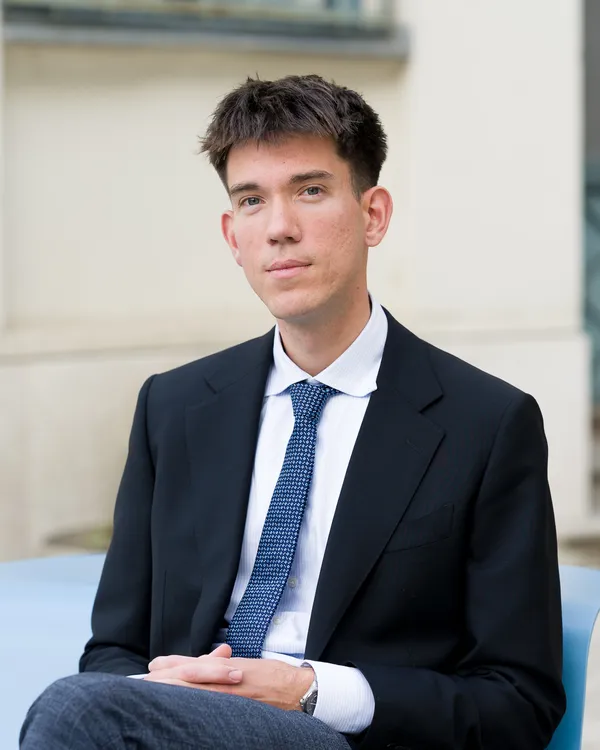
Richard holds a PhD in Machine Learning and Neuroscience from the University of Oxford, where he developed neural decoding methods and autoregressive models of brain activity. His earlier work includes conversational models and publications at ACL and EACL, followed by real-time machine-learning systems for human–computer interaction at Sonera, a neurotech startup out of Berkeley, now acquired by Apple.
He led a Foresight-funded research program, training billion-parameter Qwen2.5-based models from scratch on more than 500 hours of MEG brain recordings and releasing a reproducible training and evaluation stack. More recently, he received an AI safety grant from Foresight for curiosity-driven learning under human-like constraints and worked on the ARC-AGI-3 agent that placed 8th at both the June 30 and September 30, 2026 milestones, with a final September score of 20.
His fundamental drive is increasing the agency of the human–AI collective: improving humanity’s ability to sense, understand and act in the world. He is motivated by bringing together philosophy, physics, mathematics, information theory and thermodynamics to understand life and intelligence, and to develop AI as a natural extension of the self.
Find more of his writing here (opens in a new tab).
Côme is part of the ARC-AGI-3 research effort. Holding a master’s degree in engineering, he has built experience in the automotive industry, spanning development and system-level responsibilities in autonomous driving. He worked on solutions involving safety-related constraints in close collaboration with AI research and product teams. More recently, he has worked across applied AI topics including NeRF, Gaussian Splatting and web solutions integrating agentic AI components.